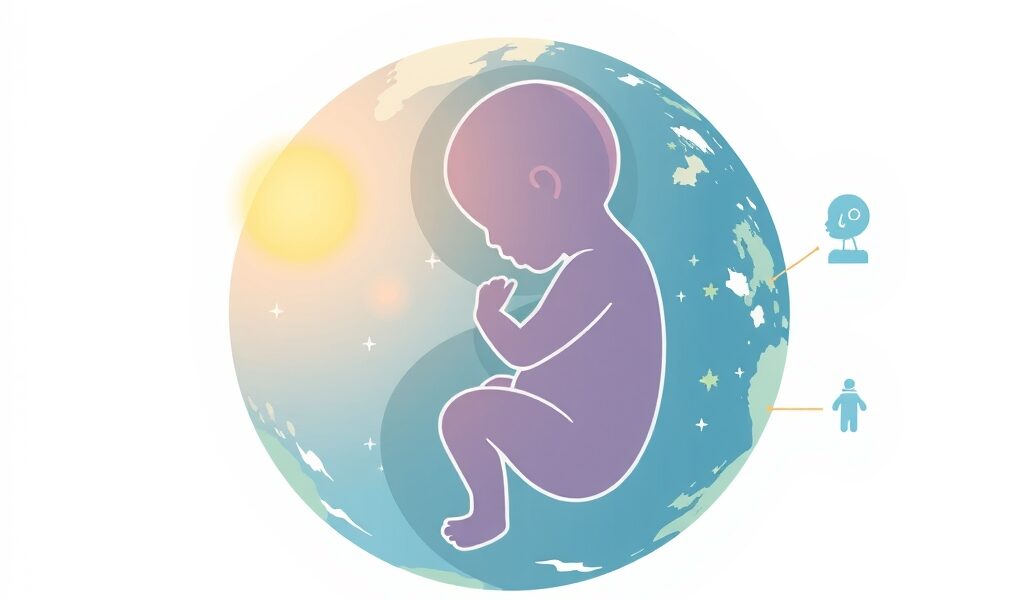
Nearly 15 million babies are born prematurely every year. These infants often weigh less than a bag of sugar and face a high risk of lifelong health challenges or death. This situation is worsening because of climate change. The threat of climate change to preterm babies requires immediate attention.
The World Health Organization and the CDC consistently state that preterm birth is a leading cause of child mortality. They confirm that environmental factors contribute significantly. In public health outreach, we frequently observe a stark connection between extreme weather events and poor maternal health outcomes.
Key Takeaways
- Rising temperatures and air pollution increase the risk of preterm birth.
- Millions of premature babies face serious health challenges globally.
- Pollutants like PM2.5 correlate strongly with early deliveries.
- Health systems must build climate resilience to protect pregnant individuals.
What is Preterm Birth?
Preterm birth happens when a baby arrives before 37 weeks of pregnancy. A full-term pregnancy lasts about 40 weeks. Because they arrive early, these babies miss crucial developmental time. Consequently, their organs may not be fully mature. This leads to immediate and long-term health problems.
Preterm birth is the leading cause of death for children under five. UNICEF reported that one million children died from preterm complications in 2020. Survivors frequently experience chronic issues like breathing problems, cerebral palsy, and developmental delays. This creates a massive burden on families in high-risk regions like South Asia.
The Evidence on Climate Change
Scientists have observed links between environment and birth outcomes for decades. Recent research shows a direct pattern. A warming planet accelerates early deliveries.
The Rising Heat
Increasing global temperatures cause frequent heatwaves. Pregnant individuals are highly vulnerable to heat stress. Chersich et al. published a meta-analysis in Nature Climate Change in 2020. They found a strong association between heat exposure and early birth. Every one-degree increase above a comfortable threshold correlates with more preterm deliveries.
Basu et al. published a study in Environmental Health Perspectives in 2016. They showed that extreme heat in the last trimester increases early labor risk. Heat stress dehydrates the mother and alters uterine blood flow. Therefore, prolonged high temperatures can push a pregnancy into early labor.
Polluted Air
Climate change worsens air pollution. Fine particulate matter (PM2.5) from wildfires and fossil fuels is particularly dangerous. Trasande et al. reviewed this in JAMA Network Open in 2019. They confirmed PM2.5 exposure as a consistent risk factor. These microscopic particles cross the placenta, causing inflammation and stressing the fetus.
Dutta et al. conducted a multi-city study in India. They published their findings in Environmental Science & Technology in 2022. They identified a strong correlation between high PM2.5 levels and increased preterm birth rates. Consequently, reducing air pollution directly improves maternal-neonatal health.
Extreme Weather Events
Extreme weather events like floods and storms also pose a severe threat. Sheffield et al. discussed this in The Lancet Planetary Health in 2021. Climate disasters disrupt healthcare access and elevate maternal stress hormones. This stress can trigger early labor.
Building Resilience in Public Health
We must focus on mitigating climate change and adapting our health systems simultaneously.
- Policy Action: Policymakers can implement stricter emission regulations. This improves air quality for everyone. Investing in renewable energy helps curb global temperature rise.
- System Adaptation: Health systems must establish early warning systems for heatwaves and air quality. Providing access to cooling centers is essential.
- Strengthening Care: Improving maternal healthcare services helps identify at-risk pregnancies quickly. Community health workers can educate pregnant women on staying hydrated and avoiding peak pollution.
By integrating climate action into public health strategies, we can protect vulnerable populations. We have the data; the next step is consistent implementation.
This article is for educational purposes only and does not constitute medical advice, diagnosis, or treatment recommendations. Consult a qualified healthcare provider for any health concerns. See our Medical Disclaimer.
Sources
- Basu R, Pearson D, Anderson M, Malig B. Association of Ambient Temperature and Preterm Birth in California: A Case-Crossover Study. Environ Health Perspect. 2016 Jan;124(1):120-6. PMID: 26162137.
- Chersich MF, et al. Associations between heat exposure and adverse pregnancy outcomes: A systematic review and meta-analysis. Nature Climate Change. 2020;10:906-917. DOI: 10.1038/s41558-020-0872-9.
- Dutta A, et al. Exposure to ambient fine particulate matter (PM2.5) and risk of preterm birth in India: A multi-city analysis. Environ Sci Technol. 2022;56(18):13233-13242. DOI: 10.1021/acs.est.2c02874.
- Sheffield PE, et al. Climate change and women’s health: a scoping review of the literature. Lancet Planet Health. 2021 May;5(5):e295-e309. PMID: 33964264.
- Trasande L, et al. Environmental Chemicals and Preterm Birth: A Comprehensive Review. JAMA Netw Open. 2019 Aug 2;2(8):e198089. PMID: 31408018.
- World Health Organization. Preterm birth. Fact Sheet. 2023. Available from: https://www.who.int/news-room/fact-sheets/detail/preterm-birth


Leave a Comment